
- The minister details 18 measures comprised in 7 blocks: reinforcement of the application of the law of the food chain; regulatory simplification; commercial issues; agricultural insurance; professional diesel; extensive livestock forum and incorporation of young people.
- It announces the creation of the State Food Information and Control Agency, with more funding and personnel, to carry out more inspections and more controls ex officio with the aim of strengthening the application of the law of the food chain.
- Planas will forward to Brussels the proposal to simplify the common agricultural policy on crop rotation or eco-systems.
- The implementation of the digital notebook will be voluntary and its adoption will be encouraged, which will result in better planning of the costs of the farms.
Luis Planas presents a package of “solid and worked” measures that responds to the concerns of farmers and ranchers
15/02/2024
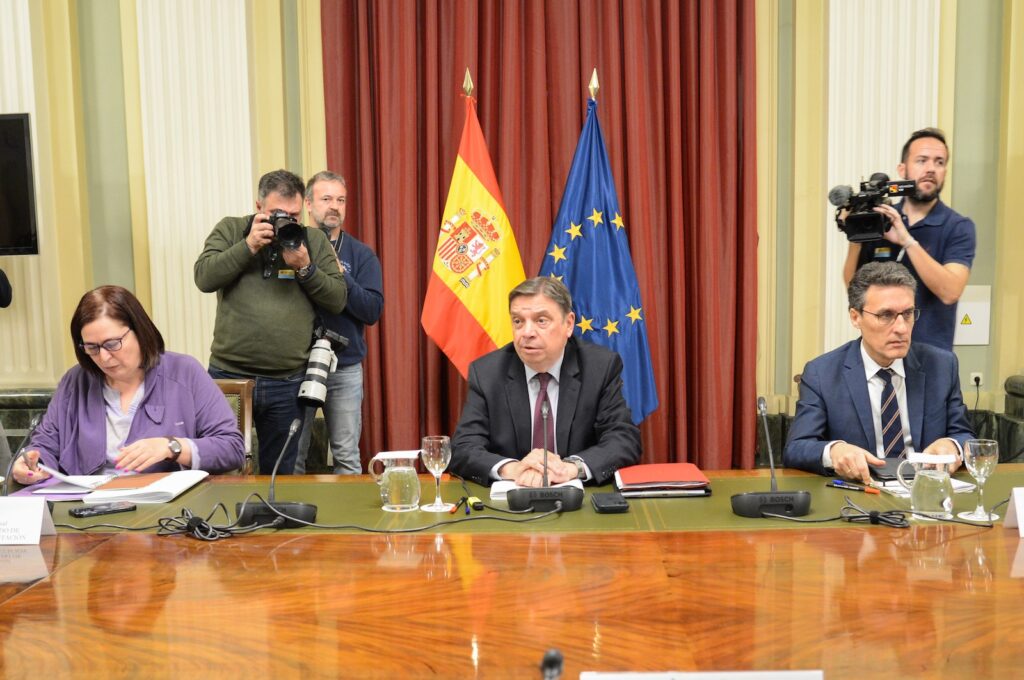
The minister details 18 measures comprised in 7 blocks: reinforcement of the application of the law of the food chain; regulatory simplification; commercial issues; agricultural insurance; professional diesel; extensive livestock forum and incorporation of young people.
The Minister of Agriculture, Fisheries and Food, Luis Planas, has presented today to the professional agricultural organizations a package of measures, “solid and worked”, to respond to the concerns of farmers and ranchers who were transferred to the Government at the meeting held on February 2.
These are 18 measures that are articulated around seven blocks and have to do with the main aspirations raised at that meeting, improvement in the application of the law of the chain, simplification of the bureaucratic and regulatory procedures of the Common Agricultural Policy (CAP) and trade agreements, among others.
The implementation of these measures affects the competences of the European Union - those relating to the CAP and trade agreements with third countries - the Government and the autonomous communities.
The minister stressed that these proposals are the result of the Government’s work, dialogue and commitment to respond to farmers and livestock farmers and announced that next week technical work will continue with agricultural organizations to advance the definition of measures, many of which will be conditioned to the results of the Council of Ministers of Agriculture of the European Union to be held on 26 June. Next Monday, the minister will meet with the autonomous communities in the Consultative Council to prepare such a Council.
The blocks of measures proposed by the minister are as follows:
STRENGTHENING THE ENFORCEMENT OF THE CHAIN LAW
Creation of a State Food Information and Control Agency. This increase in the rank of the current agency, which is an autonomous body of the ministry, will mean increasing the administrative capacity of control and inspection with greater means for compliance with the law of the chain. The creation of this agency requires the approval of a law. In addition, it is It will strengthen coordination with the autonomous communities, which the Minister said, has to assume the responsibilities that correspond to them in the inspection of contracts in the chain.
Likewise, they’ll catch up ex officio inspection plans, work for which jointly between the Government, agricultural organizations and autonomous communities the Government will identify those sectors in which priority should be given.
Likewise, provision is made for the publication of the accrual of serious and very serious sanctions Imposed for breaches of the chain’s law. Since 2023, individual sanctions have been published on a quarterly basis. The publication of the accumulated ones will have a very pedagogical character, according to the minister.
Spain too propose to the European Commission the updating of the directive on unfair commercial practicesIt is, for which the reform of the chain law approved in December 2021 will serve as a model.
SIMPLIFICATION
The Government is going to transfer to the European Union at the Council of Ministers next day 26 several proposals for simplification of regulations on Good Agricultural and Environmental Conditions (BCAM) of the Community Agricultural Policy (CAP). Specifically, the derogation for 2023 of those relating to crop rotation (BCAM 7) and non-productive areas (BCAM 8) in irrigated crops. The exemption of organic farming from organic farming will also be requested, as is already the case of BCAM 7.
In addition, the elimination of retroactivity will be requested in the calculation of the years of rotation and the possibility that it computes as rotation that one year a secondary crop has been put in place without having been used in the previous years.
For the minimum soil cover (BCAM 6), it will be proposed to allow vertical tillage between harvest and 1 September and allow the subscriber in green in that period.
Within the scope of the competences of the Government and the autonomous communities, the ministerial proposal is the simplification of the administrative burden for farmers and livestock farmers and the management of the National Strategic Plan of the CAP, proposals that have already been forwarded to the European Commission for authorisation at the Council on 26 June.
The minister has given two examples of this simplification that will benefit small and medium-sized farmers in particular: The elimination of including a georeferenced photo in the declarations to have access to the aid and restore the simplified regime for farms receiving up to 5,000 euros of aid, which translates into lower controls.
Also The catalogue of ecorregs will be expandedis, the new CAP figure introduced this year that rewards practices beneficial to the environment, to take into account particularly arid areas.
The minister has announced that the implementation of the operating digital notebook will be voluntary and that measures will be made available to encourage its implementation, given that, as explained by the Minister, it is considered a fundamental tool for improving sustainability in agricultural and livestock farms.
TRADE ISSUES
The Government is committed to defend in all international forumsand in particular in the European Union and the World Trade Organisation principle of reciprocity on the use of plant protection products in the production of food imported from third countries. If a plant protection product is banned in the EU, it should not be used in the production of food to be imported either, Planas has exemplified.
Spain will urge the European Commission to arbitrate means for improve the coordination of national customs with the aim of improving the efficiency of the Customs Union.
Luis Planas has also announced one reorganization of border inspection in Spain to improve the effectiveness of controls.
In addition, it has pointed out that in cases where the European Union has not established a maximum residue limit for substances that are not authorised on Community territory, Spain will apply, in a preventive way, a zero limit.
AGRICULTURAL INSURANCE
The Government strengthen support for the procurement of agricultural insurance, with a support line that in 2024 amounts to a total of 284.5 million euros, as well as to make the necessary contributions to adapt the different lines to the new climatic circumstances.
PROFESSIONAL DIESEL
Maintenance of the reduction in the hydrocarbon tax for diesel for agricultural use, with a rate of 3.3 cents per litre, compared to the general rate of 37.9 cents per litre.
In addition, during 2024 the validity of the reductions of 35% of the diesel bill and 15% of plastics and fertilizers in the method of objective estimation of the Income Tax for Natural Persons (IRPF) will be maintained, one of the extraordinary measures implemented by the Government to deal with the consequences of the war in Ukraine.
INITIATIVES FOR GENERATIONAL RELIEF
The minister explained that it is key for the Government and the autonomous communities to agree on articulating support to encourage the incorporation of young people, and has announced the convening of a specific Sectoral Conference to address this issue. He recalled the importance of CAP aid, which allocates EUR 220 million per year in aid for generational relief or instruments such as bonus credits.