
- The food chain law, approved in December 2021, marked a change in trade relations and met a historical demand of the agricultural sector: the prohibition of sales at a loss.
- Planas calls on agricultural organizations and agents involved in the chain to inform the AICA or its autonomous community of any irregularities they observe in the application of the law, since each complaint generates the opening of an investigation.
Luis Planas: “The Food Chain Law works and its implementation must be strengthened”
14/02/2024
The law of the food chain, approved in December 2021, represented a change in commercial relations and met a historical demand of the agricultural sector: the prohibition of sales at a loss
The Minister of Agriculture, Fisheries and Food, Luis Planas, has assured today that the amendment of the Law on measures to improve the functioning of the food chain, which entered into force in December 2021, “works” and has managed to raise prices at source to the producer. At the same time, he has advocated to “strengthen its application” through a greater effort in inspections.
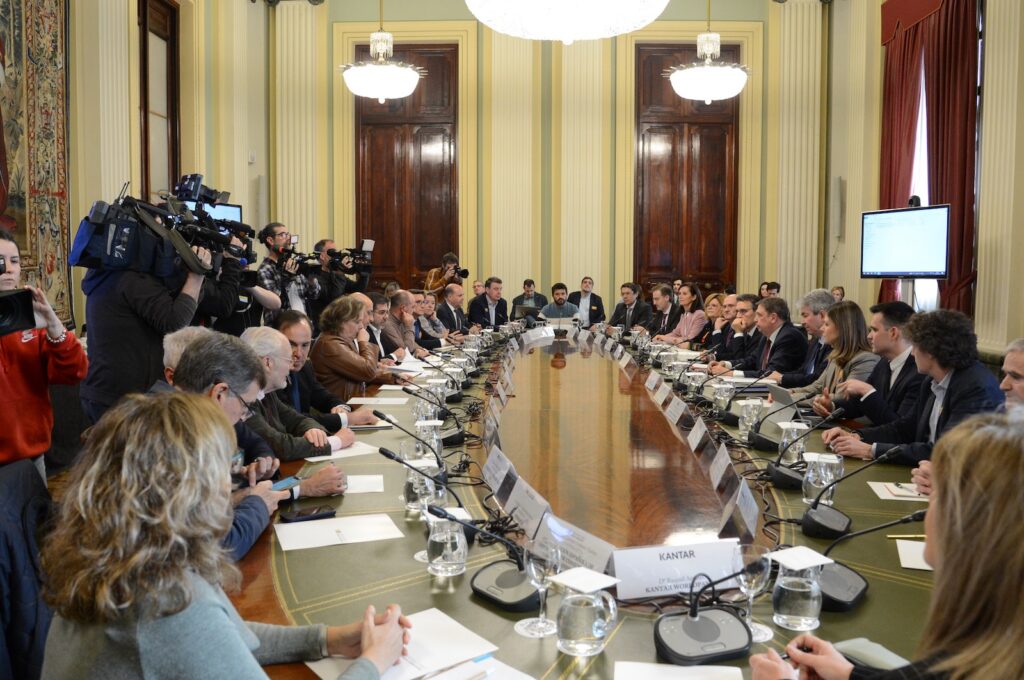
He explained that the functioning of the law is evident when analyzing what has happened with the prices at origin perceived by farmers and ranchers. “Its evolution has been positive”, he assured today during the XVII regular session of the plenary of the Observatory of the food chain, in which all agents (producers, fishermen, industry, distribution, consumers, general administration of the State and autonomous communities) are represented and which he presided over today in ministerial headquarters.
He has stated that, in general terms, the economic data available to the Ministry indicate that from January 2022 to December 2023, the prices at source have risen very significantly, even if the inflation derived from the increase in costs, which had its peak in October 2022, six months after the beginning of the war in Ukraine, is discounted.
Despite this, it has nuanced, this evaluation in macroeconomic terms must be accompanied by another microeconomic reading, which shows that there are very diverse commercial situations in which there have been greater difficulties in the application of the law of the chain in a timely manner.
To improve the functioning of this legal framework, the minister, in line with what was recently announced by the President of the Government, Pedro Sánchez, has confirmed that work is already being done to increase the inspections related to its compliance, with more analysis of the commercial relations of companies with their suppliers.
COMPETENT AUTHORITIES FOR CHAIN CONTROL
The Food Information and Control Agency (AICA), attached to the ministry, coordinates the inspection and complaints received by this organization and the enforcement authorities of the autonomous communities in charge of monitoring compliance with the law.
The minister has invited the representatives of the weakest link in the chain, the agricultural organizations, to formalize complaints from their associates to the competent authorities, while at the same time he has requested the regional leaders to deepen their work of control and processing of complaints, which always guarantee confidentiality so as not to harm the one who has presented it. The latter has also been urged to send those cost studies that they consider may be of interest and that they want to share so that they can be published in a specific section that is going to be created on the ministry’s website.
The Observatory of the food chain has brought together the representatives of the different links involved in the food chain, the Government of Spain, the autonomous communities, the trade union centers and the Council of Consumers and Users.
Participants in the meeting included heads of the Ministry of Agriculture, Fisheries and Food; Ministry of Industry and Tourism; Ministry of Economy, Trade and Enterprise; Ministry of Social Rights, Consumption and Agenda 2030 and the National Institute of Statistics (INE). The professional agricultural associations Asaja, COAG, UPA and Agro-Food Cooperatives, the National Federation of Fishermen’s Associations, the Industry and Distribution Boards (ACES, Asedas and Anged), the Spanish Trade Confederation and Obrerar Commissions CC.OO have also attended.) of Industry. In addition, there have been the fruit and vegetable organization Fepex, the National Confederation of Wholesale Fruit and Vegetable Entrepreneurs of Spain (Coemfe), the fish retailers (Fedepesca), Mercasa and the Interfood Forum. The autonomous communities Andalusia, Aragon, Asturias, Balearic Islands, Canary Islands, Castilla-La Mancha, Castilla y León, Valencia, Extremadura, La Rioja, Madrid, Murcia and Navarra also participated in this meeting.
This Observatory is convened at least twice a year, is consultative and has no inspection or sanctioning structure, since it is a forum that was conceived to provide solutions and seek improvements in the functioning of the food chain.
In this ordinary session, the first to be held in 2024, two studies have been presented that analyze the evolution of prices and consumption of food and beverages, as well as the new version of the tool of Cost and income studies of agricultural holdings. (Ecrea 2.0),designed by the Ministry’s Under-Secretariat for Agriculture, Fisheries and Food.
One of the analyses of the evolution of prices, carried out by the INE, highlights that food was the group of the Consumer Price Index (CPI) that most grew on average during 2023, with a rate of 11.7%. This percentage was higher for processed foods (13.3%) and lower for fresh foods (9.3%). The photograph at the end of the year shows a year-on-year rise in the CPI for food and non-alcoholic beverages of 7.3%, far from 15.4% in January 2023.
The report of the consultancy Kantar on food consumption in 2023 shows that, in general, the volume bought by households has stabilized, that in the last weeks of December the increase in prices slowed down and that households are increasingly betting on the option of the distributor brand when they fill their basket of packaged products. Its market share in this segment rose from 41.5% in 2022 and to 43.4% in 2023.
ECREA 2.0 INTERACTIVE REPORT
The Ministry of Agriculture, Fisheries and Food presented today at the meeting the new interactive version ECREA 2.0, already available on its website web, in order to be able to easily consult technical and economic information of productive activities. Its database is the statistics of the National Agrarian Network (RECAN).
This tool allows to consult surface data, production, income, costs and technical and economic results of the farms that make up the sample, by crops and/or livestock activities. Apart from accounting information, it allows access to the evolution of costs and economic results, as well as the territorial analysis of productions.
During the plenary session, it was reported that, in compliance with the third additional provision of the Chain Act, the ministry published the report on the elements involved in the distribution of production costs for agricultural, fishery and food products, which have been the subject of analysis in the value chain studies carried out by the Food Chain Observatory.
The studies presented today by the INE and Kantar can be consulted in the following link.
Documents: